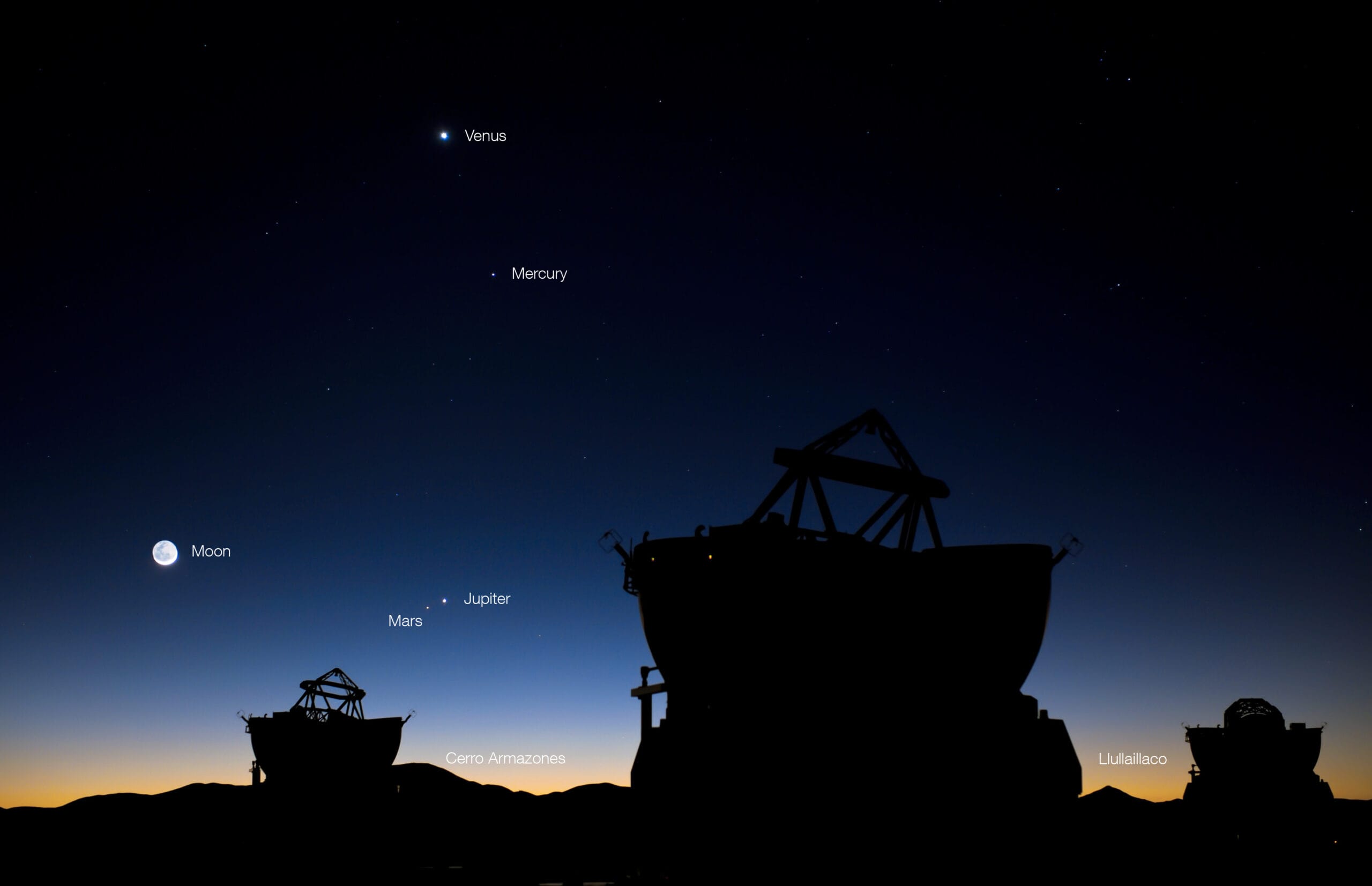
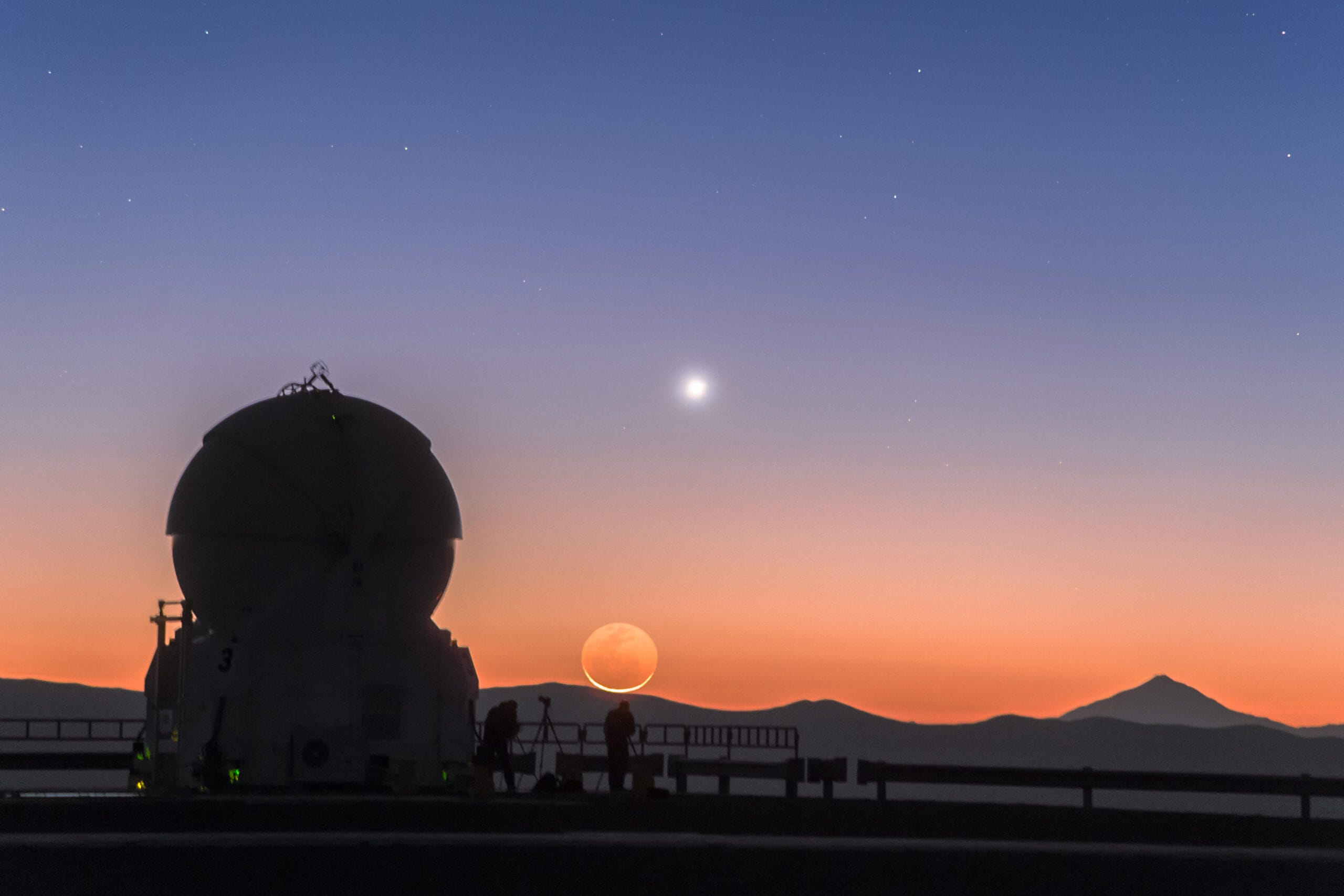
Venus is at its brightest in the UK’s morning sky in late November, and from 4 to 6 December a thin crescent Moon passes it and the star Spica low in the south-east before dawn. This guide shows you how to photograph both: the crescent phase of Venus through a telescope or long lens, and the wide-field line-up with the Moon. It is written for beginners with a camera and tripod, with extra notes for anyone who already images through a telescope.
Before you start
- For the line-up: any camera with manual exposure, a sturdy tripod and a lens between 50 and 135 mm.
- For the crescent phase: a telescope, or a telephoto lens of at least 400 mm, on a tracking or steady mount.
- Site: a clear, flat view from east to south, away from tall buildings and trees.
- Time needed: 60 to 90 minutes before sunrise.
- Useful background: the guide to lunar phases for astrophotography.
How the morning apparition of Venus works
Venus passed between Earth and the Sun (inferior conjunction) on 24 October and has since moved into the morning sky. Right after that pass it is a large, thin crescent. As it pulls away from Earth its disc shrinks and the lit fraction grows, so for a few weeks the balance between size and phase makes it brighter than at any other point in the apparition.
Greatest brightness falls on 27 November, according to the 2026 Venus event table on Derekscope, at about magnitude −4.7 (Obliquity’s Venus notes for 2026 give the same figure). That makes it the brightest object in the sky after the Sun and Moon. The table below shows what to expect from a mid-UK location (52.5°N, 1.5°W), with times in GMT.
| Date | Venus rises (GMT) | Altitude at nautical dawn | Lit fraction (%) | Disc size (arcseconds) |
|---|---|---|---|---|
| 22 November | 04:20 | 16° at 06:18 | 20 | 46 |
| 27 November | 04:08 | 18° at 06:25 | 25 | 42 |
| 1 December | 04:02 | 19° at 06:30 | 28 | 40 |
| 5 December | 03:59 | 20° at 06:35 | 31 | 37 |
A disc of around 40 arcseconds is large by planetary standards, close to the size Jupiter reaches at its best. The crescent can just be made out in steadily held 10× binoculars, and shows clearly in any telescope.
Imaging the crescent phase
The phase only shows if Venus covers enough pixels. Work out your image scale (how much sky each pixel covers) with this formula:
Image scale (arcseconds per pixel) = 206 × pixel size (µm) ÷ focal length (mm)
With a camera of 3.76 µm pixels on a 1,000 mm telescope, the scale is 0.77″ per pixel, so a 42″ Venus spans about 55 pixels and the crescent is obvious. On a 400 mm lens with 4 µm pixels the scale is about 2″ per pixel, giving a disc of roughly 20 pixels: the crescent still shows, just small. Below about 10 pixels the planet becomes a bright dot.
Exposure and capture
- Camera on a telescope or long lens: start at ISO 100 and 1/1000 s, then adjust until the brightest part of the crescent sits around two thirds of the way along the histogram.
- Dedicated planetary camera: record video at low gain with exposures of 1 to 5 milliseconds, and capture 1,000 to 3,000 frames.
- Stacking: keep the sharpest 10 to 20% of frames, stack them in planetary stacking software, then sharpen gently.
The common mistake is overexposure. Venus is so bright that an automatic exposure turns it into a round white blob with no crescent at all, so always set the exposure by hand and check a magnified preview.
Timing and the low altitude
Venus never climbs much above 20° before the sky brightens, so you are imaging through a thick layer of air. Two things help. First, wait for twilight: between nautical dawn and sunrise Venus gains a few degrees and the brighter sky reduces glare around the disc. Second, a red or infrared-pass filter reduces the colour fringing (atmospheric dispersion) that splits the planet into a blue and a red edge at low altitude.
Stop observing through any optics once the Sun is about to rise. Venus is around 40° from the Sun this month, and sweeping a telescope or long lens towards the Sun risks permanent eye damage.
The Moon, Venus and Spica from 4 to 6 December
Early in December the waning crescent Moon slides past Venus and Spica, the brightest star in Virgo. BBC Sky at Night Magazine’s guide to the morning Venus describes the same sequence, and the positions below are for mid-UK at nautical dawn.
- 4 December: a 21% lit Moon sits about 6° from Spica, with Venus about 13° to the lower left. Spica lies between the two.
- 5 December: a 13% lit Moon sits about 7° below and to the right of Venus, and Spica completes a compact triangle about 8° from both. This is the pick of the three mornings.
- 6 December: a 7% lit Moon is only about 5° high at nautical dawn, so you need a clear, flat south-eastern horizon.
On 5 December the Moon rises at about 04:30 GMT from mid-UK and Venus is about 20° up by 06:35. The best window runs from about 06:15 to 07:15, while the sky turns deep blue and the Moon is still clear of the horizon haze. From Edinburgh, civil dawn comes later (about 07:40) with the Moon about 14° high at that point; from southern England the Moon stands a few degrees higher, at about 18° at civil dawn.
Settings for the wide-field shot
- Framing: an 85 to 135 mm lens on a full-frame camera (50 to 85 mm on APS-C) fits the 5 December triangle with room for a foreground.
- Focus: magnify live view on Venus and focus until it is as small as it gets.
- Exposure: ISO 400 to 800 at f/4 to f/5.6, starting at 1 second in deep twilight and shortening as the sky brightens.
- Earthshine: the faint glow on the unlit part of the Moon needs two to four times the exposure that suits the crescent, so bracket and blend the frames later.
A static tripod is enough: at these focal lengths, exposures of 2 seconds or less keep the Moon and Venus sharp. Include a landmark on the south-eastern horizon to give the scene a sense of scale, as in the Mars and Jupiter conjunction imaging guide from earlier this month.
Quick reference
| Target | Date | Window (GMT, mid-UK) | Where to look | Starting settings |
|---|---|---|---|---|
| Crescent Venus at its brightest | Late November | 06:00 to 07:30 | South-east, about 15° to 22° high | ISO 100, 1/1000 s, 400 mm or longer |
| Moon, Spica and Venus | 4 December | 06:15 to 07:15 | South-east to south-south-east | ISO 400, f/5.6, 0.5 to 1 s, 85 mm |
| Moon, Venus and Spica triangle | 5 December | 06:15 to 07:15 | South-east, Moon about 14° high | ISO 400, f/5.6, 0.5 to 1 s, 135 mm |
| Thin Moon below Venus | 6 December | 06:30 to 07:15 | Low in the south-east | ISO 800, f/4, 1 s, 85 mm |
Next steps
Start with the crescent phase on the first clear morning, because Venus grows smaller each week and the crescent thickens. Check the forecast the evening before and pick a site using the steps in planning a night of stargazing. The next big event after the December line-up is the Geminid meteor shower on 13 to 14 December, close to new Moon this year, and the guide to photographing meteors from the UK covers the settings for it.