Mars and Jupiter pass 1.2° apart in the pre-dawn sky on Monday 16 November 2026, close enough to share the field of a modest telephoto lens or a short-focus telescope. This guide gives UK times and altitudes, then shows you how to frame the pair at three focal lengths, from a wide landscape to both planetary discs in one frame. It suits anyone with a camera and tripod, and the telescope section adds detail for those already imaging the planets.
Before you start
- Kit: any camera that takes manual exposures, a sturdy tripod and a remote release; a lens from 24 mm to 600 mm, or a telescope up to about 900 mm focal length.
- Time: the pair rises at about 23:00 GMT on 15 November and is well placed from 01:00 until civil twilight begins at about 06:50.
- Prior knowledge: the exposure triangle, covered in the astro.pics guide to ISO, aperture and exposure time.
- Backup mornings: 15 and 17 November, when the gap is still under 1.3°.
How the conjunction works and where to look
A conjunction is a line-of-sight effect: Mars is about 1.3 astronomical units from Earth and Jupiter about 5.3, but from here they appear side by side in Leo. Their closest approach is 1.19° at about 02:04 UT on 16 November, according to a calculation from the JPL DE421 ephemeris. The Royal Observatory Greenwich November highlights give the same 1.2° and place the pair high in the south at 05:30.
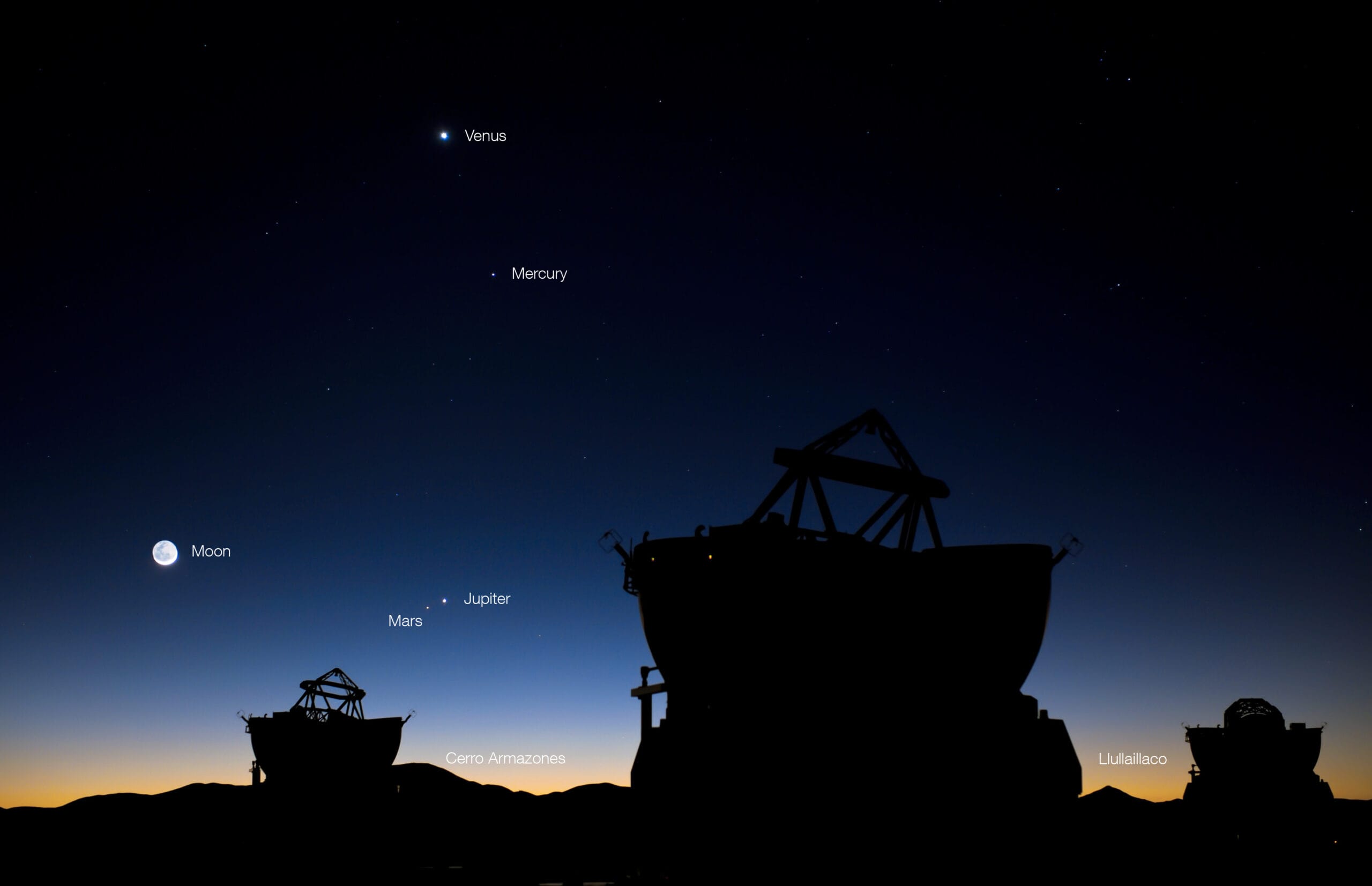
Jupiter is the brighter of the two at about magnitude −2.1, with Mars at +0.7 and noticeably orange. Mars sits just over a degree above and slightly left of Jupiter when you face south. Regulus, the brightest star in Leo, lies about 4.4° from Jupiter, so the three make a neat triangle in a short telephoto frame.
The table below gives the altitude and direction of the pair on the morning of 16 November from a mid-UK location (52.5°N), computed for this guide and checked against the Royal Observatory chart. All times are GMT.
| Time (GMT) | Altitude (°) | Direction | Sky |
|---|---|---|---|
| 23:00 (15 Nov) | 0 | East-north-east | Dark; Moon set at 21:00 |
| 01:00 | 17 | East | Dark |
| 03:00 | 35 | East-south-east | Dark |
| 05:00 | 48 | South-south-east | Dark |
| 06:00 | 51 | South | Nautical twilight |
| 06:50 | 51 | South | Civil twilight begins; sunrise 07:29 |
From southern England the pair stands 2° to 3° higher at dawn; from northern Scotland it peaks at about 46° and twilight starts 15 to 20 minutes later. The waxing crescent Moon sets at about 21:00 on 15 November, so it plays no part. Note that the pair is high in the south by dawn rather than low in the east, which matters when you plan a foreground.
Wide field: the pair over a landscape
For a landscape shot, image between 01:00 and 03:00, when the planets are 15° to 35° up in the east. Later in the night they climb too high to sit above a building or tree line in a single frame unless you shoot in portrait at 24 mm.
- Lens: 24 mm to 50 mm, focused manually on Jupiter using live view at maximum magnification.
- Settings: f/2.8 to f/4, ISO 800 to 1600, about 4 seconds at 24 mm or 2 seconds at 50 mm, which keeps trailing under 2 pixels on a sensor with 4 µm pixels.
- Foreground: take a second, longer exposure for the land and blend the two later.
The common mistake is trusting autofocus or the infinity mark on the lens. Both leave Jupiter as a soft blob; focus on it in live view until it is as small as possible.
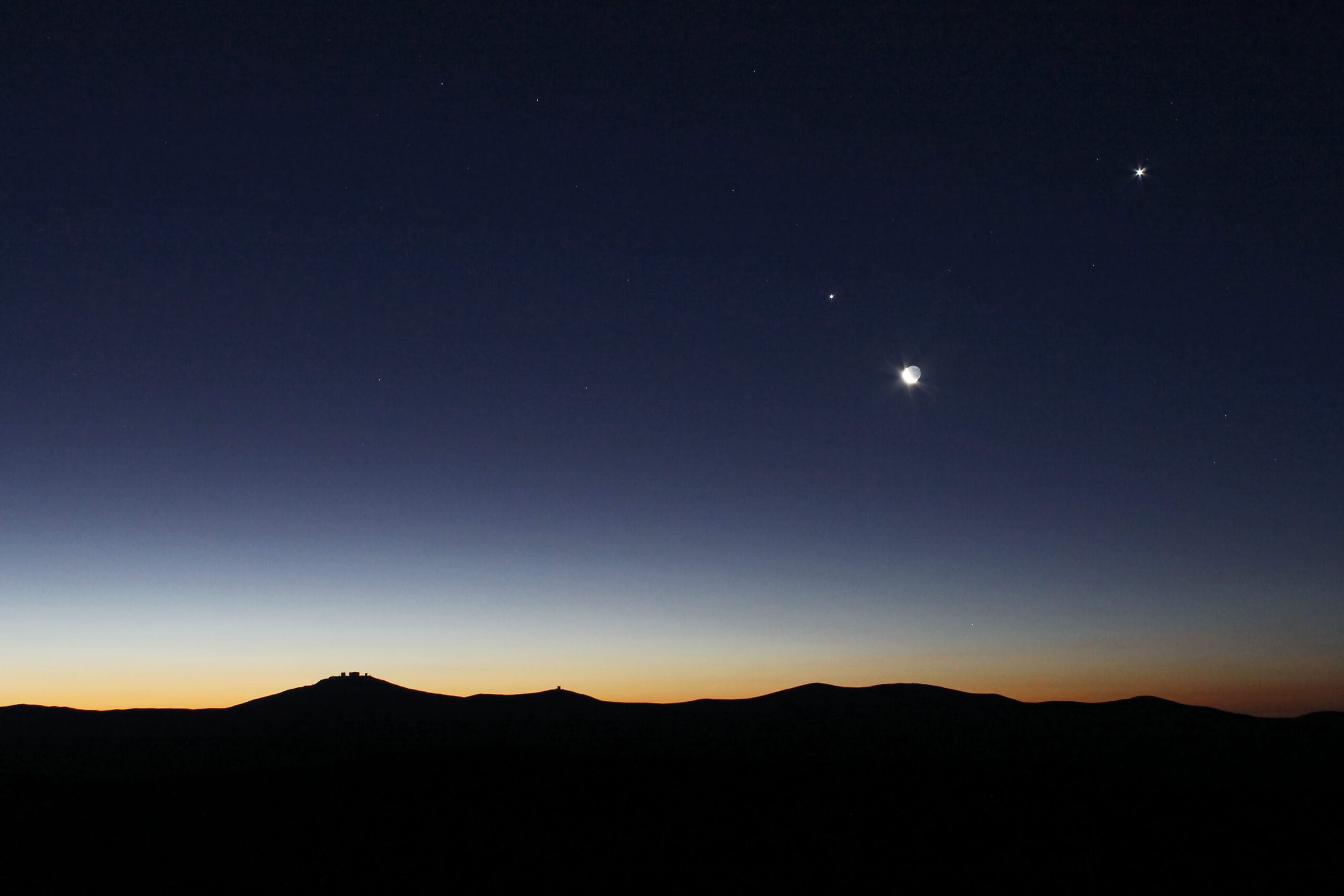
Telephoto: Mars, Jupiter and Regulus
A telephoto lens turns the two dots into an obvious pair and lets you add Regulus. To frame all three with a margin, you need a field at least 6° wide. The table shows which focal lengths deliver that.
| Focal length (mm) | Full-frame field (°) | APS-C field (°) | What fits |
|---|---|---|---|
| 135 | 15.2 × 10.2 | 9.9 × 6.6 | Pair, Regulus and much of Leo |
| 200 | 10.3 × 6.9 | 6.7 × 4.5 | Pair and Regulus |
| 300 | 6.9 × 4.6 | 4.5 × 3.0 | Pair and Regulus (full frame only) |
| 600 | 3.4 × 2.3 | 2.2 × 1.5 | Pair only, with Jupiter’s moons as dots |
On a fixed tripod the sky drifts quickly at these focal lengths. At 300 mm with 4 µm pixels the planets move about 5 pixels every second, so keep exposures to 1/4 second or shorter, or use a star tracker for longer ones. Start at ISO 400 and f/5.6, then check the histogram: Jupiter should show a little colour rather than a white clipped disc.
The common mistake here is a single exposure that suits Jupiter but loses Regulus and the fainter stars. Take a short frame for the planets and a set of longer ones for the stars, then blend them, as you would for a bright Moon beside a star cluster.
Through a telescope: both discs in one frame
To fit both planets on the sensor, the field must be wider than about 1.5°. With an APS-C sensor that means a focal length of 900 mm or less; with a smaller 1-inch sensor, about 500 mm. At 900 mm with 3.76 µm pixels, Jupiter’s 37″ disc spans about 43 pixels and Mars’s 7″ disc about 8, with the four Galilean moons alongside.
- Point at Jupiter and focus on its moons, not on the disc.
- Take short exposures for the planets: around 1/100 second at ISO 200 and f/7 is a starting point, adjusted until Jupiter’s belts are not clipped. Mars is brighter per unit area than Jupiter, so it records well in the same frames.
- Take a second set at about 1/10 second to bring up Jupiter’s moons.
- Stack each set and blend them, keeping the separation true.
For detailed close-ups, image each planet on its own with a planetary camera and video capture. At about 51° before dawn, Jupiter is close to the highest it can climb from mid-UK, so on a night of steady seeing this is a good session for lucky imaging. The common mistake at this scale is drift between frames; even a tracking mount needs a careful alignment so the pair stays centred during capture.
Quick reference
| Setup | Best time (GMT) | Starting settings |
|---|---|---|
| 24 to 50 mm landscape | 01:00 to 03:00, looking east | f/2.8 to f/4, ISO 800 to 1600, 2 to 4 s |
| 135 to 300 mm telephoto | 04:00 to 06:00, looking south-east to south | f/5.6, ISO 400, 1/4 s or shorter on a tripod |
| Telescope up to 900 mm | 04:00 to 06:30, looking south | 1/100 s for the planets, 1/10 s for Jupiter’s moons |
If 16 November is cloudy, the separation is 1.23° on the 15th and 1.27° on the 17th, and still under 1.7° from 13 to 19 November. Check the forecast the evening before, using the tools in the beginner’s guide to planning a night of stargazing. BBC Sky at Night Magazine also notes Venus and Mercury low in the south-east before sunrise in mid-November, if you have a clear horizon.
Next steps
Start with the wide-field shot, since it needs the least kit and gives you a usable image even through thin cloud. The Leonid meteor shower peaks two nights later, on the night of 17 to 18 November, so leave the camera set up and read how to photograph meteors from the UK before you go out.